Know which pods run a new CVE the moment it is published.
Free for one cluster. Cancel in one click.
StackRadar is a Kubernetes vulnerability scanner. It keeps a package list for every running image and checks it against each new advisory as it lands. No rescan.
- One Helm command
- First findings within minutes
- Only package lists leave the cluster
Just want a one-off scan? Use the CLI, no account needed.
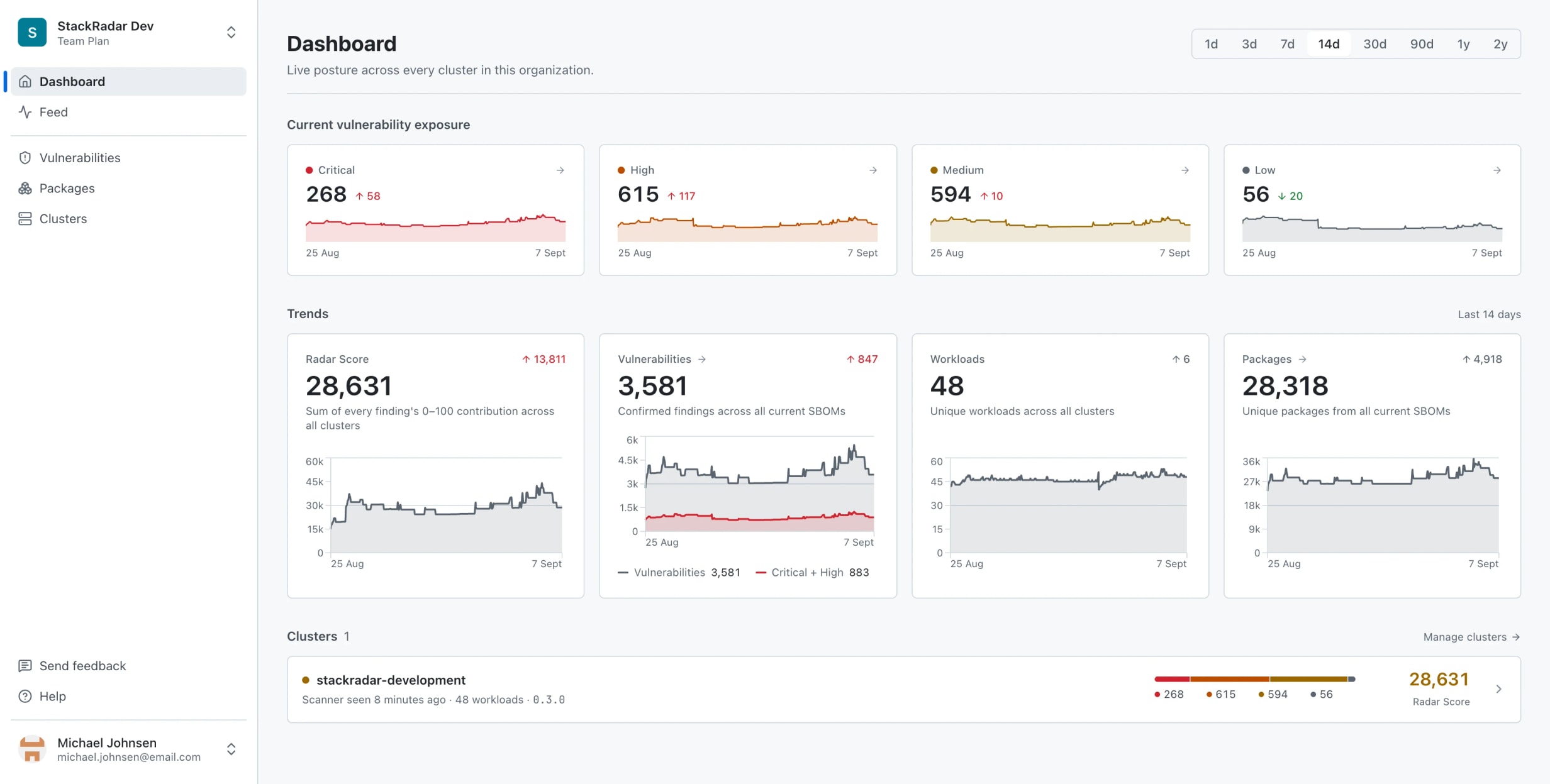
The dashboard below, on a simulated cluster. Read-only.
Nothing you have to take on trust. Every moving part is a public project you can look up, and every finding links back to its source.
Know what is actually running, not what you pushed.
CI scans the image you built. The cluster runs whatever is left: old tags, hotfixes, the sidecar someone added by hand. StackRadar watches the cluster itself and lists every namespace, workload and container, with the Helm release or Argo app that put it there. Nothing to register, nothing to forget to scan.
How the scanner worksAnswer “are we affected?” before the rescan would have started.
When a CVE makes the news, the question arrives before the fix does, and the usual answer is a full rescan of every cluster. StackRadar already holds the package list for every image, so a new advisory is checked against all of them the moment it lands. You read the answer. Nothing is scanned again.
How matching worksFind every copy of the next Log4Shell in one search.
A headline CVE names a library, and the scramble is finding every image that ships it. Type the package name and see every image and workload running it, across every cluster, with the versions in play and the ones that are already clean.
What an SBOM recordsNot a demo dataset.
The same pipeline runs nightly across every public Helm chart, so you can see what it finds before it runs in your cluster.
One Helm command. Nothing else to wire up.
No CI plugin, no registry credentials to hand over, no rescan schedule to babysit.
- 1
Install once
One Helm command, on EKS, GKE, AKS or anything else that runs Kubernetes. It runs inside your cluster, so there is nothing to grant from outside.
- 2
The inventory writes itself
The scanner finds every container image and writes down what is inside it: package names and versions, nothing else. That list is all that leaves your cluster.
- 3
The answer is already waiting
Every new advisory is checked against your stored package lists the moment it lands. Open the dashboard and the affected workloads are already listed, ranked by what attackers actually exploit — and a weekly summary lands in your inbox. No rescan.
Your images, source code and secrets never leave your cluster. The scanner’s source is public, so you can check that yourself.
Fix what attackers actually use first.
Sorted by CVSS, a 9.8 nobody exploits outranks a 5.3 under attack today. Here it is the other way round.
A critical on paper
- Severity
- Critical (9.8)
- Chance of exploit
- Almost none
- Exploited right now
- No
A medium under attack
- Severity
- Medium (5.3)
- Chance of exploit
- Certain
- Exploited right now
- Yes, on the CISA list
Three public inputs, shown next to every score: CVSS for severity, EPSS for the chance of exploitation, and the CISA KEV catalogue for exploitation right now. Your cluster’s Radar Score is the sum, and it falls as you fix.
How the Radar Score worksThe three reasons not to install this, answered.
Why not the free tool you already run, where your data goes, and whether any of it can be checked.
Already running Trivy Operator?
Keep it if you have one or two clusters and only need to know what is vulnerable today. Add StackRadar when you want every cluster in one place, a dated history you can show an auditor, and new advisories checked without a rescan. The two run side by side without conflict.
Where does my data go?
No images, no source code, no secrets. Only package names, versions and workload names leave your cluster, over one outbound connection, to servers in the EU. Keeping a current list like that for everything you run is also what the EU Cyber Resilience Act and NIS2 expect of you.
Can I check any of this?
Yes. The scanner's source is public and every release is signed. Every finding links to its public advisory on osv.dev, so you can verify it against a database we do not own. And the prices are on this page, not behind a sales call.
Full detail, including how to report a vulnerability, is on the security page.
No per-node pricing. No sales call.
Every plan, including Free, covers every image in a cluster. You pay for more clusters, longer history and more seats.
- FreeFor individuals evaluating or running a single cluster.$0No credit card required1 cluster1 user30 days of history & saved SBOMsStart free
- ProMost popularFor engineers running production workloads who need full visibility.$99at stable releaseSave $40/mo$59/monthPrice locked for as long as you subscribeUp to 5 clustersUp to 10 team members1 year of history & saved SBOMsGet started
- BusinessFor platform teams running fleets across environments.$299at stable releaseSave $100/mo$199/monthPrice locked for as long as you subscribeUp to 15 clustersUp to 25 team members2 years of history & saved SBOMsGet started
What people check before installing.
Why not just use Trivy Operator? It is free.
Often you should — for one or two clusters where you only need to know what is vulnerable right now, it is a genuinely good answer. The difference: Trivy Operator stores scan results inside each cluster and they expire after a day, so it has to rescan and each cluster stands alone. StackRadar keeps the dependency list itself, outside the cluster, so new advisories are checked against it without a rescan, across every cluster at once, with a dated history. See the Trivy Operator section above for when to stay.
What is an SBOM?
A Software Bill of Materials: the list of everything inside a container image — OS packages, libraries, runtimes, their versions, and licenses. It contains only names and versions, never source code, secrets, or image contents, which is why sending it to StackRadar is safe.
How does the scanner work?
It runs inside your cluster, scans each new image with Syft as it appears (plus a full sweep every 6 hours), and uploads only the resulting SBOM together with what is running where. Vulnerability matching happens on our side. The How it works section above walks through each step.
Where does the vulnerability data come from?
From OSV.dev — an open, public vulnerability database run by Google. It gathers security warnings from many sources: GitHub Security Advisories, Linux distributions (Debian, Alpine, Ubuntu, and others), and package ecosystems like npm, PyPI, Go, Maven, RubyGems, and crates.io. StackRadar keeps its own always-fresh copy of these 900K+ warnings and checks your dependency lists against it. Because the data is open, there is no black box: every finding links to its public advisory, and you can double-check any result yourself on osv.dev.
How do I know what to fix first?
Findings are ranked by a risk score that combines three things: how bad the flaw could be (its CVSS severity score), how likely attackers are to actually use it (its EPSS probability, updated daily), and whether attackers are already using it right now (the CISA Known Exploited Vulnerabilities list). So a flaw being used in real attacks outranks a scary-sounding one nobody touches, and your list starts with the findings that matter.
Does my image data leave the cluster?
The scanner runs inside your cluster and sends exactly two things to StackRadar: the dependency lists (package names, versions, and licenses — none of your own code) and a list of what is running where (namespace and workload names, image references, Helm chart versions, ArgoCD application names — from a short fixed list of well-known labels, never anything else). Your actual container images, source code, secrets, and environment variables never leave your network. Everything you upload is stored and processed only on servers in the EU.
Which Kubernetes distributions are supported?
The scanner works on any standard Kubernetes cluster — EKS, GKE, AKS, DigitalOcean Kubernetes, k3s, kind, and self-managed clusters. It uses the standard Kubernetes API and its access is read-only: it lists and watches pods, plus optional read-only lookups of workload controllers and ArgoCD applications for attribution. It never creates, modifies, or deletes anything.
What licence is the scanner under?
The scanner and its Helm chart are published under the PolyForm Shield 1.0.0 licence — "source-available", which is not quite the same as open source. Every line of code that runs in your cluster is on GitHub, so you can read it, check it, run it, and change it for your own use. The only thing the licence forbids is reselling it as a competing service. Every release is signed and carries a verifiable record of how it was built, so you can check that the image you download really came from that code. The dashboard (where findings are shown and tracked) is the paid part.
Does it support private container registries?
Yes. The scanner automatically uses the same credentials your pods already use (their imagePullSecrets) when it pulls images to read their contents. This works with any standard registry — ECR, GCR, Docker Hub private repos, GitHub Container Registry, and self-hosted registries.
How often does it scan?
The scanner works in two complementary modes: it watches for pod events in real time so new or updated images are scanned as soon as they appear, and it performs a full cluster sweep every 6 hours (configurable via Helm values) to ensure nothing is missed. Each distinct image is scanned once per cluster. You can also choose which namespaces are scanned using include or exclude lists, and skip specific images by name pattern.
Can I cancel anytime?
Yes. No contracts, no commitments. Cancel from your dashboard with one click. You'll keep access until the end of your billing period. The scanner itself is free and will continue to run in your cluster.
How do I get in touch?
Email contact@stackradar.io for anything — questions, feedback, enterprise pricing, or help with an install. A person reads it and replies. Security reports go to security@stackradar.io; see the security page for disclosure details.
The next CVE lands whether or not you are ready.
Since 11 September 2026 the EU Cyber Resilience Act gives manufacturers 24 hours to report an actively exploited vulnerability. Knowing which pod runs it is step one, and one Helm install keeps that answer current. Free for one cluster. Cancel in one click.
- One Helm command
- First findings within minutes
- Only package lists leave the cluster
Just want a one-off scan? Use the CLI, no account needed.